
If you operate an RV park or campground in Florida, you’ve likely felt two things at the same time this year: You’re sitting far from empty… but it can feel like guests are shopping harder, booking later, and expecting more.
That combination is exactly what 2026 looks like. Florida’s demand engine is still powerful, but the way guests choose where to stay has shifted. The operators who treat 2026 like “business as usual” will feel more friction. The operators who adjust their pricing, marketing, and guest experience to match today’s buyer will do just fine—and in many cases, have a record year.
Let’s talk about what’s changing and what to do about it.
Florida still has the demand
Florida continues to post historic tourism volumes, and that matters even if your guests don’t think of themselves as “tourists.” When a destination stays hot, outdoor lodging benefits: drive markets stay strong, shoulder seasons have more opportunity, and families looking for value often choose camping and cabins when hotels get expensive.
In other words, Florida isn’t losing its draw. The guest is still coming. The difference is that guests now behave more like online shoppers than traditional vacation planners.
The real shift: guests are buying differently
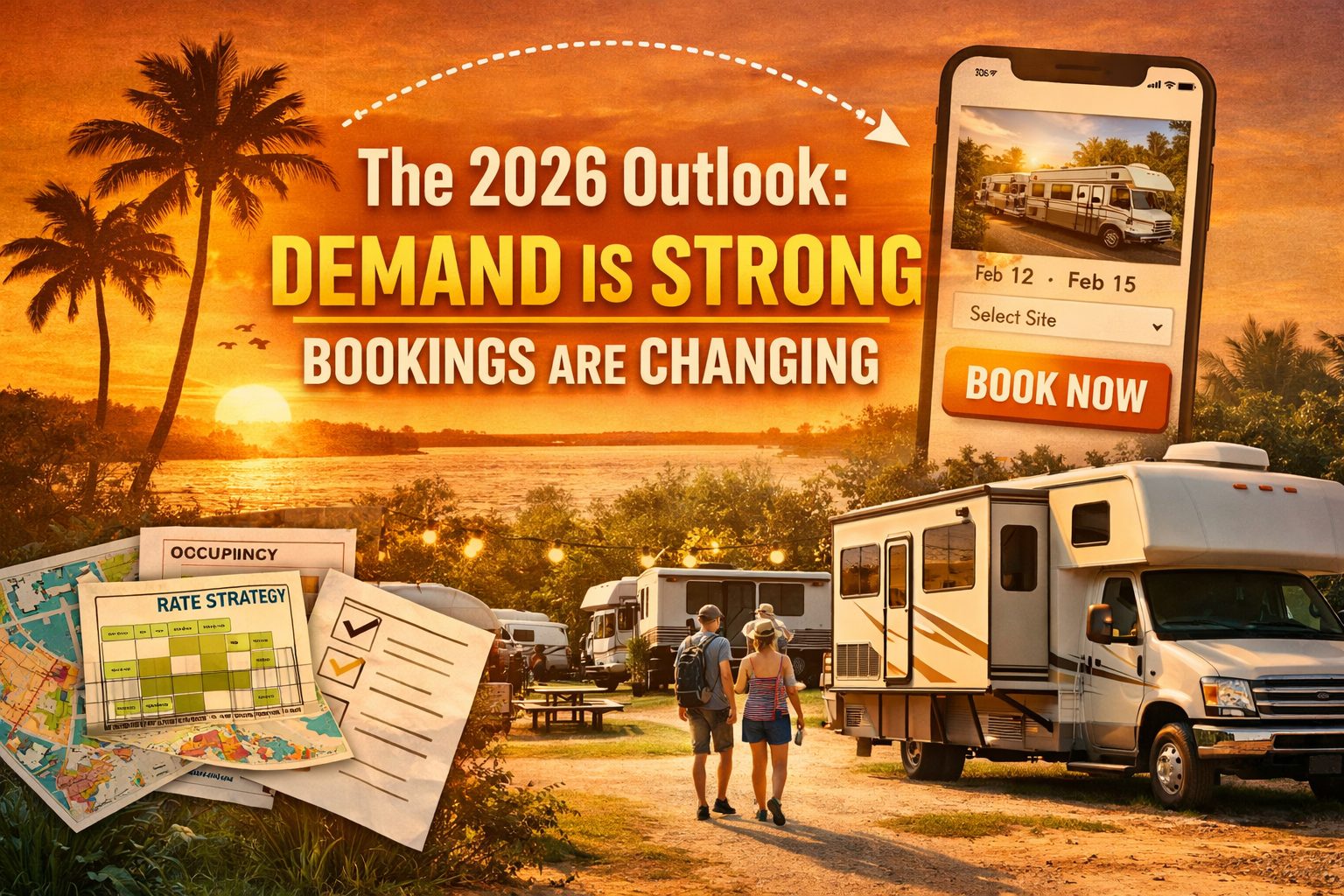
The most important story heading into 2026 isn’t “will we have demand?” It’s this: More guests are deciding later, comparing more options, and booking on their phones.
That shows up in shorter booking windows and a more competitive “last 60 days” environment. Many parks can still end up with strong occupancy, but the path to getting there may feel less predictable—especially if you’re used to being comfortably booked far in advance.
This is where operators get into trouble: not because demand disappears, but because they rely on an old rhythm that no longer matches how people shop.
What 2026 will reward (and what it will punish)
In Florida, 2026 will reward parks that are clear, easy, and confident.
Clear means your website and messaging answer the big questions quickly: what am I getting, what does it cost, what are the rules, and what will my stay actually feel like?
Easy means booking takes seconds, not minutes—especially on mobile. The guest doesn’t have to hunt for site info, call for basic questions, or guess what the fees will be.
Confident means your rates and policies don’t wobble. You don’t train guests to wait for discounts, and you don’t let your best inventory get “cheapened” because a slower week made you nervous.
On the flip side, 2026 will punish parks that feel confusing, outdated, or hard to book. Even if you’re a great park, a great park that looks complicated online loses to a good park that feels simple and trustworthy.
A note about winter: still your advantage, but don’t treat it as automatic
Winter remains a major Florida advantage, but some markets are likely to see more variability from traditional snowbird segments—especially Canadians. That doesn’t mean winter will be weaker. It means you should be deliberate about protecting it.
The simplest way to think about it is this: if you’ve historically relied on one segment to fill long stays, 2026 is the year to strengthen your bench.
That means improving how you attract and convert domestic long-stay guests (Midwest and Northeast are obvious targets), and making the long-stay booking process easier and more confidence-building. Long-stay guests don’t want mystery. They want clarity: what’s included, what utilities cost, what the rules are, what the vibe is, and what happens if plans change.
The 2026 operator playbook: less chaos, more control
Here’s the good news: you don’t need a “big complicated strategy” to win 2026. You need tighter execution in a few areas that directly impact revenue.
1) Make your website do the selling
Your website shouldn’t be a brochure—it should be a reservations tool.
If you improve only one thing heading into 2026, make it this: a mobile shopper should be able to understand site types, see the right photos, and book quickly without confusion.
That means fewer surprises (fees, policies, check-in rules), better organization by site type, and stronger “proof” (reviews, guest photos, or a simple “why guests choose us” section).
2) Protect rate by getting smarter about discounting
A lot of Florida parks will feel some degree of rate resistance at times, especially in more competitive corridors. The mistake is reacting with blanket discounts.
Instead, protect your best revenue nights and premium inventory and use targeted tools to fill the rest: midweek incentives, shoulder-season value, longer-stay offers, or bundling add-ons that cost you little but feel valuable (late checkout, a firewood bundle, or a simple “stay 3 nights, get X”).
In 2026, the goal isn’t “never discount.” The goal is “discount with purpose,” so you don’t erode your rate structure.
3) Own the last 60 days
If booking windows are shorter, your marketing has to show up when decisions are being made.
You don’t need fancy marketing. You need consistent marketing:
- Always-on Google Search so you show up when someone is ready to book.
- Retargeting so shoppers who visited your site come back.
- Simple email reminders to past guests.
- Steady social proof—reviews, guest experiences, events, “what it’s like this week.”
This is how you replace unpredictability with a repeatable demand engine.
4) Use guest experience as “rate insurance”
When guests shop harder, experience becomes pricing power.
Parks that keep Wi-Fi solid, bathhouses consistently clean, and arrivals smooth can hold rate better than parks that don’t. These aren’t glamorous upgrades, but they reduce refunds, prevent negative reviews, and make it easier for guests to choose you without hesitation.
Put bluntly: in 2026, operational excellence will show up in your bottom line more than ever.
A simple 30-day plan to get ahead of 2026
If you want something your team can actually execute quickly, do this over the next month:
- Refresh your photo set so every site type is represented clearly.
- Tighten your booking path on mobile (test it yourself—no guessing).
- Update policies/fees so they’re easy to find and easy to understand.
- Decide your rate “floor” and stop panic discounting.
- Build a basic last-60-days marketing cadence (Search + retargeting + email).
Those five steps alone will reduce the “choppy demand” feeling and give you more control heading into peak planning for 2026.
The bottom line
Florida is still Florida. Demand is there. RV interest remains strong. But the guest is booking later, comparing more, and expecting simplicity.
In 2026, the parks that win will be the ones that feel easiest to choose: clear, confident, and frictionless—online and on property.